
Coffee Translates
Why a simple cup keeps becoming common ground in a divided world.

Rich and I have been saying this phrase a lot lately:
Coffee translates.
Usually it comes up when we’re standing behind a coffee cart somewhere in the city. An office building. A school. A lobby. A neighborhood event. Some place where people are moving from one thing to the next, half-present, checking their phones, trying to figure out where they’re supposed to be.
Then the coffee shows up.
And something changes.
Not in a dramatic way. Nobody stops the room and announces that a meaningful community moment is about to happen. It’s quieter than that.
Someone smells the coffee. Someone asks what we’re serving. Someone says, “I’ll take whatever has the most caffeine.” Someone else asks if we have decaf and then apologizes for asking, even though they don’t need to. A little line forms. People who weren’t talking a minute ago now have something simple to talk about.
The coffee gives the room a reason to gather.
That is what I mean when I say coffee translates.
It moves between worlds.
It works in office buildings and schools and neighborhoods. It works with executives and teachers and students and parents and contractors and people who are having a great day and people who are barely making it through the morning.
Coffee does not need everyone to have the same background before it can be shared.
That feels more important to me than it used to.
We live in a world that is very good at sorting people. We draw lines quickly. Political lines. Cultural lines. Generational lines. Economic lines. Lifestyle lines. Some lines are necessary. Some tell the truth. But a lot of them become lazy shortcuts. They help us decide who belongs where before we’ve ever sat across from each other.
Coffee pushes back on that, even if only for a few minutes.
It creates a kind of middle ground.
Not a fake middle ground where nothing hard matters. Not a place where we pretend differences disappear. I don’t believe coffee fixes everything. A latte is not reconciliation. A coffee shop is not a solution to every problem a neighborhood carries.
But coffee does something small that we probably underestimate.
It lowers the barrier to being near each other.
It gives people a reason to pause without needing an agenda. It lets someone be welcomed before they are understood. It makes room for presence before explanation.
That has always been part of what I love about coffee shops.
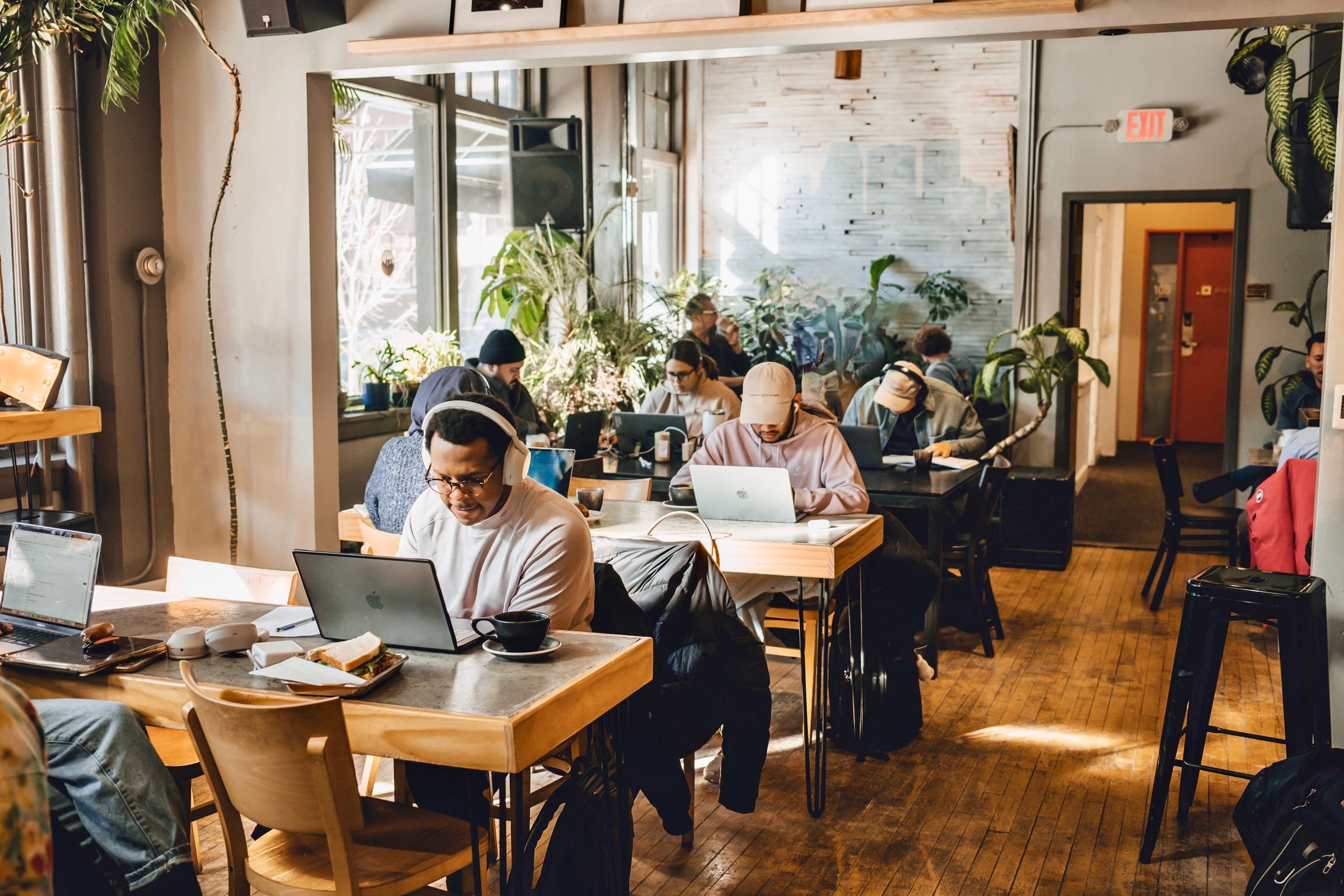
A good coffee shop is one of the few places where people can still belong lightly. You don’t have to explain why you’re there. You can meet someone. You can work. You can sit alone. You can be a regular. You can be new. You can be in a hurry. You can stay longer than you planned.
And somehow all of those things can happen in the same room.
That is rare.
When I think about Corner Coffee, I think about that kind of room.
Yes, I care about the drinks. I care about the details. I care about the design, the smell of the space, the way the light hits the tables, the way the bar flow works, the way people feel when they walk in.
But underneath all of that, I care about what the space makes possible.
A neighbor might find a place where they are known by name.
A student might find a table where they can study for a few hours.
A parent might have their first calm moment of the morning.
A business owner might take a meeting that turns into something bigger.
Someone new to the city might find a place that makes the neighborhood feel a little less unfamiliar.
Someone lonely might not have to say they are lonely. They can just order coffee and be around people for a while.
That matters.
Because connection often starts smaller than we want to admit.
It starts with a cup across a counter. A familiar face. A table that is open. A place where nobody has to perform to be welcomed.
Coffee translates because it gives people a shared language before they have shared history.
And maybe that is why it keeps working.
In a divided world, we keep looking for big solutions. Better arguments. Stronger platforms. Clearer positions. Louder voices.
Sometimes what we need first is a lower table.
A place to stand close enough to remember that the other person is not a category. They’re a person. They drink coffee. They have a morning. They have a story. They have places where they feel tired and places where they still hope.
Coffee cannot carry all of that by itself.
But it can open the door.
Related reading
If this connected with you, here are a few other pieces that live in the same neighborhood:
Why Each Shop Is a Little Different
On why each Corner Coffee has to reflect the neighborhood it belongs to.
Why We Ask Your Name
On the small acts of recognition that make a coffee shop feel human.
When Coffee Becomes a Transaction
On what gets lost when coffee becomes only a product instead of a place of connection.