
How We Price Coffee
Transparency, compromise, and why the number on the bag actually matters

TL;DR
The price you pay for a bag of coffee is directly connected to what the farm is paid.
Higher-quality coffees cost more because they pay more upstream and reward intentional farming.
We price coffee using real costs—not vibes—so pricing can be traced back through the supply chain.
Transparency doesn’t remove complexity, but it helps people understand what they’re supporting.
Supporting a local roastery creates opportunities far beyond your cup—locally and globally.
Pricing anything is hard.
I don’t enjoy it. I don’t think most people do.
Coffee adds another layer of complexity because it’s not just a product—it’s the result of a long chain of people, decisions, labor, and risk that eventually turns into a number on a bag.
And the question underneath all of it is simple, even if the answer isn’t:
How do you price coffee in a way that honors the people who made it possible—without turning it into something unreachable?
That tension never really goes away. We live in it.
The Forces Pulling on Every Price
There are a few forces pulling on price at the same time:
Fairness - Coffee comes from somewhere. Someone grew it, processed it, moved it, graded it, exported it, shipped it, imported it, stored it, and finally roasted it.
Fairness means those people aren’t invisible.Reality - Coffee has real costs that exist whether the coffee is cheap or expensive—equipment, loss during roasting, labor, packaging, rent, compliance, storage, shipping, fees/taxes, and more.
Accessibility - If the coffee is incredible but nobody can buy it, what did we actually accomplish?
Pricing is the attempt to hold all three at once.
It’s rarely clean. It’s never perfect.
Sometimes it means certain coffees cost more than we wish they did.
Sometimes it means we pass on coffees we genuinely admire because we don’t see a responsible way to price them.
Flavor Comes Before Price
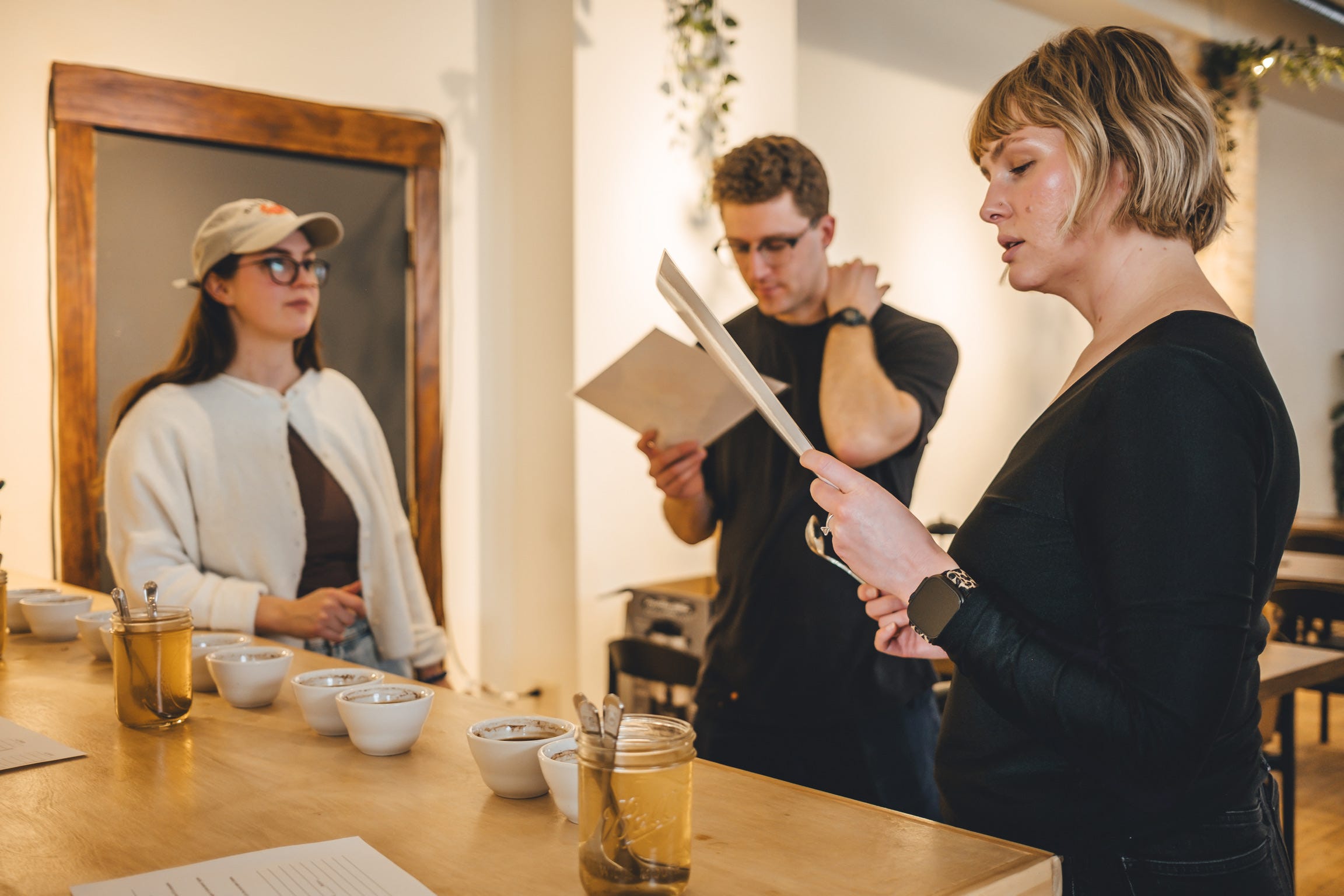
Before price ever enters the conversation, we choose coffees through blind cupping.
When we’re tasting, we don’t know the origin, the producer, the importer, or the cost.
We only know what’s in the cup.
That’s intentional.
It keeps flavor at the center and prevents us from justifying a coffee because it’s expensive—or dismissing one because it isn’t.
(I’m working on a separate post that goes deeper into how we select coffees—it deserves its own space.)
The Most Important Thing to Understand About Price
This is the part we want to be clear about:
The price you pay for a bag of coffee is directly correlated to what the farm is paid.
A more expensive coffee isn’t more expensive by accident.
It’s more expensive because more money is paid upstream.
That matters because it shapes incentives.
Paying more for quality-focused coffees encourages farms to prioritize:
careful picking
thoughtful processing
experimentation and refinement
long-term sustainability over raw volume
The largest players in the industry are optimized for quantity.
That’s their role.
Ours is different.
We’re interested in discovering coffees defined by intention, quality, and care—often from regions or producers that don’t yet have the spotlight.
That’s why we’re excited about coffees like our upcoming India release—
our first-ever coffee from India, sourced direct from a single, family-owned farm.
We even had the chance to host one of the sons from the farm in our Uptown shop to cup coffee together. That kind of relationship doesn’t exist when price is disconnected from people.
More info about that coffee coming soon.
Why We’re Sharing Landed Cost
We’re beginning to include our landed cost per pound of green coffee on some of our bags.
This is what it costs for the green coffee to arrive to us—including shipping and logistics—not just what’s paid at origin.
We’re doing this because we don’t think price should feel mysterious.
But landed cost is only the starting point, not the full story.
What Happens After Coffee Arrives
Once coffee reaches us, it’s still raw material.
Green coffee loses weight during roasting as moisture is released.
A pound in does not equal a pound out.
Then there’s packaging, production labor, equipment, maintenance, storage, and fulfillment—costs that exist no matter how modest or exceptional a coffee is.
These aren’t optional.
They’re the infrastructure that allows coffee to be roasted consistently and responsibly.
How We Build a Price
We think about pricing in two main parts:
Landed Cost - What we pay per pound for the green coffee once it’s in our hands.
Fixed Costs - Costs that remain consistent regardless of the coffee—packaging, production, equipment assumptions, and operational overhead.
Together, these form our break-even.
From there, pricing scales intentionally.
Wholesale pricing exists to support partners who are serving our coffee in their own spaces.
Retail pricing reflects a different cost structure than wholesale. It carries the added weight of retail rents, shop labor, merchandising, and the reality that we hold and manage inventory ourselves rather than moving it in bulk.
The key thing is this:
Our prices are tied by formula to what we paid. They’re traceable, not arbitrary.
Why Traceability Matters
Coffee hasn’t always been priced in a way that’s easy to understand—or easy to follow back to the people who made it.
When pricing lacks clarity, value tends to drift away from producers and toward whoever has the most leverage.
We’re not pretending a label fixes that.
But we do believe that traceable pricing—built from real costs and real relationships—is a better starting point than vague storytelling.
This is still a work in progress.
We’re learning, refining, and trying to communicate more clearly as we go.
Education matters here—not so everyone becomes an expert, but so people can make informed choices if they want to.
Where This Leaves Us
Supporting a local roastery isn’t just about buying coffee close to home.
It’s about choosing a system where:
quality is rewarded over volume
relationships matter more than scale
and dollars move intentionally—from your cup to people around the world
Every bag creates opportunity—locally and globally.
For producers. For roasters. For communities.
Our hope isn’t that you agree with every number.
It’s that you understand what you’re supporting when you pick up a bag.
We’ll keep trying to make that path easier to see.
I'm assuming this was written by AI?
I was totally expecting you to actually break down the price of your coffee and show us your opex, capex, margins, etc.
It's kind of crazy to click on "How We Price Coffee" and not see a single dollar figure, any hint of a formula, and zero math!