
My Hot Take on Cold Brew
It’s the most popular way to drink cold coffee. I think it’s the worst one.

I need to say something, and some of you are not going to like it.
I don’t like cold brew.
Not “not really my thing.” Not “I’ll have a sip if you’re buying.” I mean I almost never drink it, and if you handed me one right now I would find a polite way to give it back to you.
This is a personal opinion. Plenty of people at Corner love cold brew. Some of you order it every single day of the summer, and I am genuinely happy for you. This is not an intervention.
But I’ve been thinking about why I feel this way, and I think it’s actually about something bigger than my own taste buds. So here’s my hot take on cold coffee.
Humans have been trying to solve this problem forever
People have wanted cold coffee for a very long time.
In 1840, French soldiers stationed in Algeria were drinking coffee mixed with cold water, sugar, and lemon over ice. They called it Mazagran, and it might be the earliest documented iced coffee tradition anywhere. Yes, our Lemon Brew has 185-year-old roots.
Kyoto cafes were building slow-drip cold towers as far back as the mid-twentieth century, dripping iced water through a bed of coffee for eight or ten hours, one drop at a time, into a decanter.
American diners spent most of the twentieth century doing something simpler and worse. Brew hot coffee, let it get old in a pot, and pour whatever’s left over ice the next day. For a long time, that was what “iced coffee” in America meant.
Which is honestly part of why cold brew took off. It was better than what most people were doing. But “better than the worst option” is a very low bar.
And somehow, out of every option humans have tried in the last two centuries, batch immersion cold brew is the version that ended up as the American default.
That’s the one I don’t like.
My actual problem with cold brew
Here’s the thing. Cold brew always tastes like cold brew.
Not like the coffee. Like the process.
At Corner, we spend a lot of energy trying to celebrate what makes each coffee different. The washed one that tastes like green apple. The natural one that tastes like it snuck into a fruit stand. The one that’s weird in a good way and the one that’s just clean and quiet and honest. That’s the whole point. The coffee is the star, or at least the starting place.
It’s also why we don’t roast anything very dark. Push a roast far enough and every coffee starts tasting like the roast itself. Smoke. Char. Burnt sugar. Bitterness that all reads the same no matter where the coffee came from. The process takes over. You stop tasting the coffee. You start tasting what happened to the coffee.
Cold brew does the same thing, just with time and cold water.
Steep any coffee, good or bad, expensive or cheap, in cold water for twelve to twenty-four hours, and you get roughly the same drink. Smooth. Low acid. Mellow. Fine.
It’s just not very coffee-flavored coffee.
I’ve watched this happen behind our own counter. Swap the coffee we use for cold brew and almost nobody notices. Swap the coffee we use for our flash brew, and people notice immediately. Sometimes before we’ve even told them we changed anything.
The science backs this up, a little
I’m not going to pretend I ran a lab experiment in the back of the shop. But real researchers have looked at this, and it lines up with what I taste.
A study out of Thomas Jefferson University compared hot and cold brewed coffee made from the same coffee across light, medium, and dark roasts. Hot brew came out more acidic, with higher antioxidant levels, across every roast. Cold brew came out smoother and less acidic. But it also flattened out some of the differences that roast level and origin usually create.1
Hot water is a much more aggressive, more complete way to pull flavor out of coffee. Compounds like chlorogenic acids, the ones most responsible for a coffee’s brightness, clarity, and origin character, extract efficiently in hot water and only slowly and partially in cold. Volatile aromatics, the fragile compounds that make one coffee smell like blueberry and another smell like brown sugar and cocoa, mostly need heat to be released at all.
Cold water, given enough time, will still pull out caffeine, body, and a certain broad “coffee” flavor. It just skips a lot of the interesting stuff on the way there.
That’s what I mean about the process taking over. The method is doing so much of the tasting for you that the coffee underneath barely gets to speak.
Enter flash brew, thank God
This is where flash brew comes in. You might know it as ice brew, or Japanese iced coffee, because specialty cafes in Japan were doing this technique long before it showed up on American menus.
The method is simple.
You brew coffee slightly stronger than normal. Roughly 60% of the total water is hot brewing water. The other 40% is ice, sitting in the bottom of the server before you start. The hot water hits the grounds like any normal pour-over or batch brew. The resulting coffee drips directly onto that bed of ice.
You can do this in a big batch brewer for the shop, or as a single pour-over for one person and their cup at home. If you have a Chemex or a V60 sitting in your kitchen, you can try flash brew this afternoon. Put your ice in the carafe first, then bloom and brew as normal with the reduced hot-water amount. Done.
The win here is that the coffee is still brewing hot.
That matters, because hot water is doing real work during that extraction. It’s pulling out the acidity, the aromatics, the identity of the coffee, fast and efficiently. Then the ice hits it immediately and locks that flavor in place before anything can fade or oxidize.
This is the trick regular iced coffee never had. You can brew hot coffee and let it cool in a fridge, sure. But as it sits, the aromatics evaporate and the whole thing gets a little tired. Flash brew skips that decay entirely.
It’s the closest thing we have to “this coffee, but cold,” instead of “a cold coffee-flavored drink.”
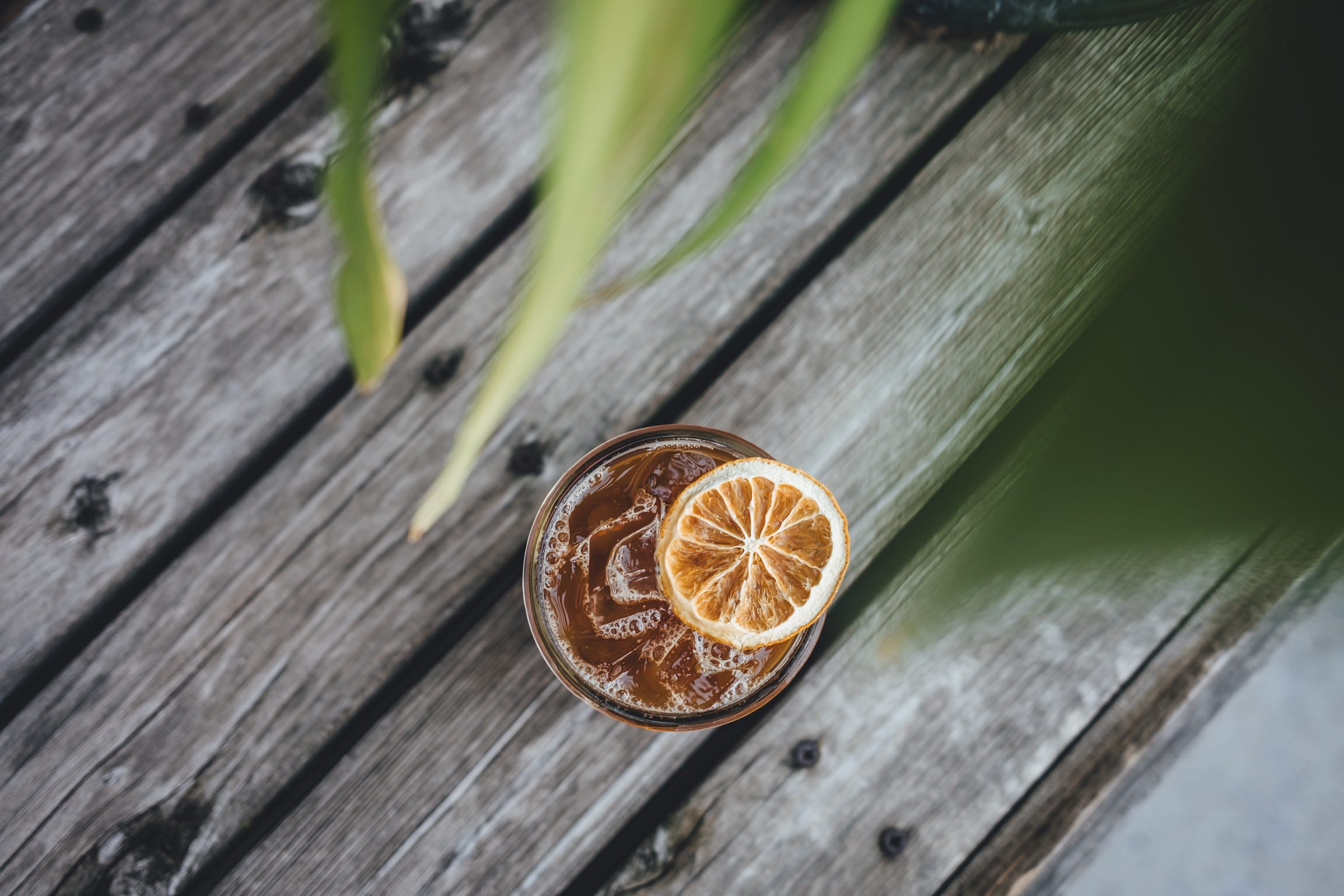
Our Lemon Brew this summer is built on this exact idea. It uses flash brew as its base, because we wanted a drink where you could still taste actual coffee underneath the lemon, not a vague coffee-adjacent backdrop.
Every method is still a compromise
I’ve written before that coffee is always a compromise. Grind finer, gain sweetness, lose clarity. Pull a shot longer, gain body, lose focus. There’s no version of coffee that avoids trade-offs entirely, and cold coffee is no exception.
Cold brew compromises flavor to gain smoothness, low acidity, and a giant batch you can make once and pour all week. It is genuinely efficient. It is genuinely easy to drink. And it works fine for people who mostly want a caffeinated cold beverage that tastes broadly like coffee.
Flash brew compromises full extraction, since you’re using less water, to gain the actual character of the coffee. Some of the later-extracting sugars get left behind, so the cup can feel a little sharper or less rounded than the same coffee brewed hot.
I know which compromise I’d rather drink. I will take a coffee that tastes a little incomplete but still sounds like itself over a coffee that’s fully extracted into tasting like nothing at all.
Fight me about it
Look, I know cold brew isn’t going anywhere. We’ll keep making it all summer, because plenty of you genuinely love it, and hospitality means making the drink people actually want, not just the drink I approve of.
But if you’ve never tried flash brew side by side with cold brew, using the exact same coffee, do that this week. Taste them back to back. See if you can tell which one still tastes like a specific place a specific coffee came from.
Team Cold Brew or Team Flash Brew?
Reply and tell me I’m wrong. Or come find me at the counter this summer and we can argue about it in person, over a cup of whichever one you want.
Related reading
Sources and further reading
Physiochemical Characteristics of Hot and Cold Brew Coffee Chemistry: The Effects of Roast Level and Brewing Temperature on Compound Extraction: The 2020 Thomas Jefferson University study (Rao, Fuller, and Grim) behind the acidity, antioxidant, and roast-level notes in this post.
1: Rao, N.Z., Fuller, M., & Grim, M.D. (2020). “Physiochemical Characteristics of Hot and Cold Brew Coffee Chemistry: The Effects of Roast Level and Brewing Temperature on Compound Extraction.” Foods, 9(7), 902.